Lobes of the Brain

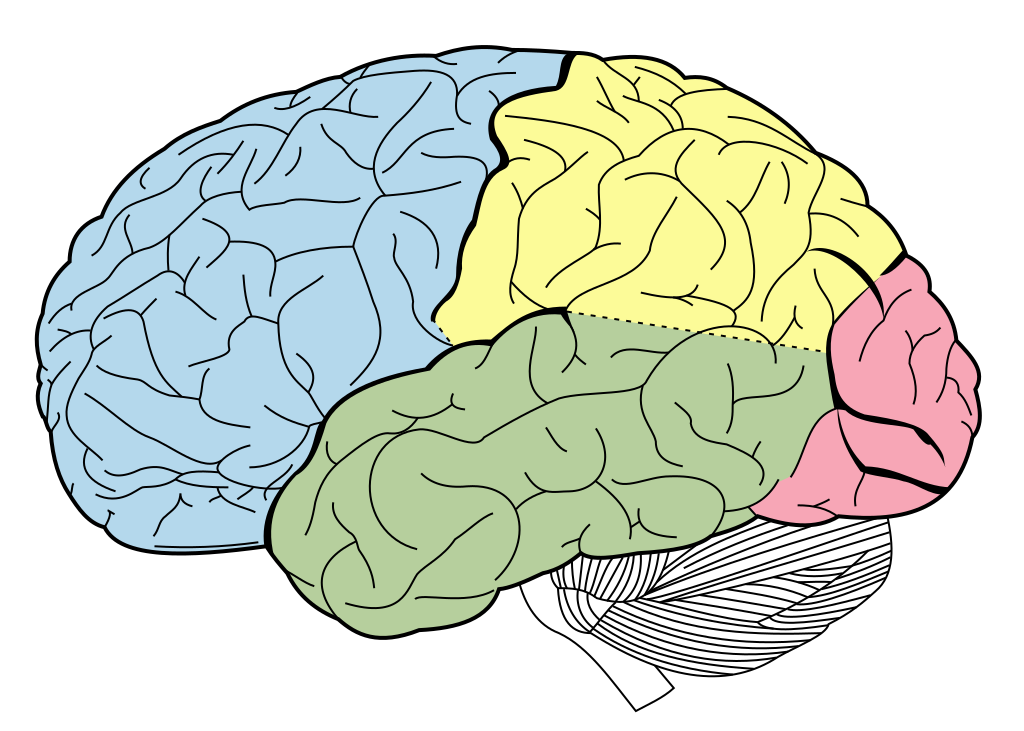
The cerebrum is the largest part of the human brain that is divided into two hemispheres. These hemispheres are connected by a bundle of nerve fibers known as the corpus callosum, which allows the hemisphere to communicate with each other. The cerebrum is divided into four lobes that each have a unique function (pictured below).

Image result for cerebrum lobes"

The frontal lobe is directly above the eyes at the front of the brain. It controls voluntary movement, speech, memory, emotion, and higher cognitive skills such as planning and problem-solving. The parietal lobe, located behind the frontal lobe, receives sensory signals and processes taste. The occipital lobe located at the back of the cerebrum processes visual information and the temporal lobe, located at the side of the brain, interprets auditory information.

                                                                                                                    ________

Image Credit:
(1)“Cerebrum Lobes.” Wikimedia Commons, upload.wikimedia.org/wikipedia/commons/thumb/0/0e/Lobes_of_the_brain_NL.svg/800px-Lobes_of_the_brain_NL.svg.png.

Comments

Popular Posts

Paul Broca and "Tan"

Paul Broca is one of the most influential neuroscientists best known for his patient, Tan. Well, his name wasn't really Tan. His name was Louis Victor Leborgne, and his incredibly unusual neurological disorder settled a debate about the location of language capabilities in the brain. In 1861, Leborgne approached Broca at the Bicetre Hospital to receive surgery for a leg infection. Leborgne had suffered from several medical conditions prior to his surgery; he had epilepsy at a young age and subsequently lost his ability to produce fluent speech. It was Leborgne's language disorder that really caught Broca's attention. Leborgne could think properly, but whenever he tried to communicate with Broca and verbalize his thoughts, all that came out of his mouth was the meaningless word "tan." For this reason, many scholars of neuroscience simply refer to Leborgne as "Tan". Broca realized that he could learn about our language capabilities by studying Leborg...

The Plasma Membrane and the Fluid Mosaic Model

Let's take a look at a cell. One thing that you will find common among all cells is the cell membrane - whether it's an animal cell, a plant cell or a bacterial cell. While this layer may only be ten nanometers thick, it has an intricate molecular structure designed for efficient transport of material into and out of the cell. This property is known as selective permeability , the control of the passage of materials across the cell membrane. The cell membrane is designed in a way that substances having certain properties are unable to enter or leave the cell (this movement across the cell boundary is known as transport ). The fluid mosaic model  describes how substances, mainly cholesterol, phospholipids and proteins, slide freely in the membrane. First, let's start with the phospholipid bilayer . A phospholipid a complex lipid with a "head" and a "tail". The head is made of one polar/hydrophilic phosphate group and a glycerol molecule. The ta...

A Mnemonic For Carbon Prefixes

Organic chemistry is the study of molecules containing the element carbon. Carbon is one of the most important elements in living things as it makes up the backbones of many molecules. There are some prefixes that you should know that indicate the number of carbons in a molecule. Meth- indicates one carbon, eth-  indicates two, prop-  indicates three, but-  is four, pent-  is five and hex-  is six. For example, methane has one carbon, ethane has two, propane has three, butane has four, a pentose sugar has five carbons and a hexose has six. A helpful mnemonic to remember these prefixes: meat eaters prefer buttered, peppered ham.                                                                                                ...